

Imperial Cylindrical Bushing Size Selection: What to Measure Before Ordering
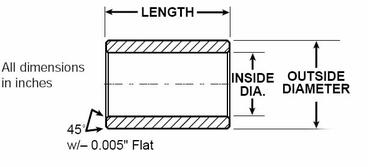
Measure your shaft and housing before ordering an imperial cylindrical bushing—send PM Distributors the dimensions and operating details.
Ordering by appearance is unreliable. A bushing that looks identical can have the wrong bore, outside diameter, length, material or clearance for the assembly. Accurate measurements and operating information reduce avoidable returns and fitting delays.
What Is an Imperial Cylindrical Bushing?
An imperial cylindrical bushing is a plain sleeve bearing specified in inch-based dimensions. It supports relative movement between a shaft and housing and may be produced from porous sintered material that retains lubricant.
PM Distributors supplies a range of imperial cylindrical bearings alongside metric cylindrical, flanged, thrust, spherical, solid and hollow sintered products. PM Distributors supplies rather than manufactures the stocked range.
Which Dimensions Must Be Confirmed?
Record:
- Shaft diameter
- Housing bore
- Required bushing length
- Existing wall thickness
- Any flange dimensions
- Shoulder, chamfer or lubrication features
- Available installation clearance
- Quantity and required delivery date
Measure the shaft and housing rather than relying only on the worn bushing. Wear, distortion and removal damage can make the old component an unreliable dimensional reference.
What Operating Details Affect Selection?
Dimensions are only the starting point. Tell the supplier:
- Radial and axial load conditions
- Shaft speed and duty cycle
- Operating temperature
- Lubrication arrangement
- Exposure to dust, moisture or chemicals
- Shaft and housing materials
- Whether motion is rotary, oscillating or intermittent
- Original part number or equipment model
Do not claim that all sintered bronze bushings are maintenance-free, suitable for heavy loads or interchangeable with machined bearings. Performance depends on material, lubricant, porosity, fit, alignment, load, speed and temperature.
Why Are Sintered Bushings Used?
Powder metallurgy can produce near-net-shape components with controlled porosity and repeatable geometry. Oil-impregnated pores can release lubricant during operation and reabsorb it when stationary.
These characteristics do not guarantee lower costs or longer service life. PM Distributors publishes technical information for sintered bearings that should be reviewed with the product specification.
See the Metal Powder Industries Federation overview of powder metallurgy bearings for manufacturing context. Supplier confirmation still takes priority.
Check Fit Before Pressing the Bushing
Press fitting can alter the internal diameter of a porous bushing. Incorrect housing size, poor alignment or excessive installation force may damage the component. Installation tooling should support the bushing correctly and avoid contaminating its pores.
Where the application is safety-critical or technically uncertain, obtain engineering advice. A distributor can help identify a stocked component, but it should not be expected to redesign an assembly from incomplete measurements.
Send a Quote-Ready Bushing Enquiry
Provide a drawing where possible. If replacing an existing part, include photographs, the original part number and measurements taken with suitable instruments. State whether an exact replacement is essential or whether alternatives can be considered.
Its credible lead proposition is access to a broad bearing range and product support—not vague promises about eliminating machining scrap.
Need an imperial cylindrical bushing identified? Contact PM Distributors with the bore, outside diameter, length, application and quantity to request availability and pricing.
Optimized by: Netwizard SEO