
The Importance of Green Strength in Powder Metallurgy Process
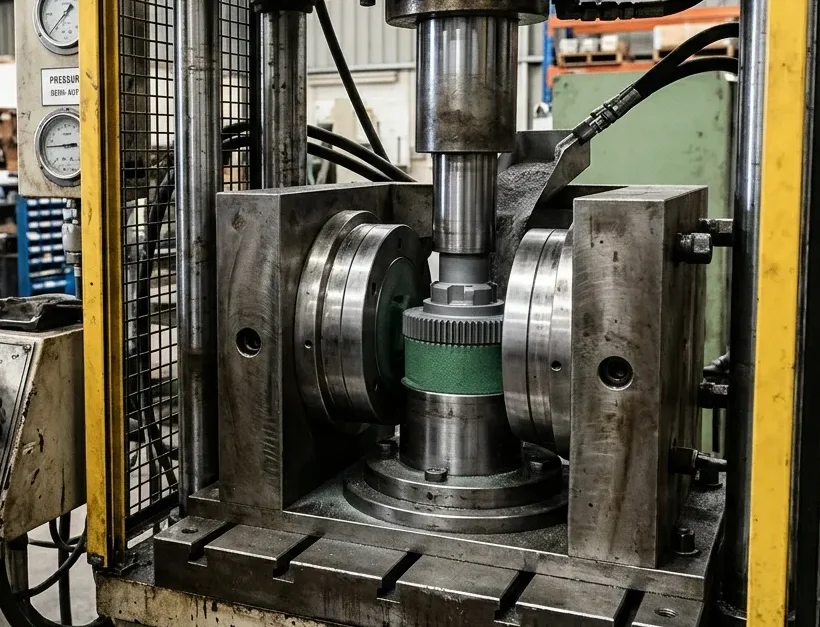
As compacted metal powders coalesce, and this is before the sintering process, the compressed material is imbued with what’s known as “Green strength.” Remember, the metal particles haven’t bonded yet, haven’t fused with each other. However, the unsintered product is mechanically tough enough to handle machining operations. Those supplementary stages won’t damage the compacted workpiece, nor will they remove the part’s surface details.
What Is Green Strength?
Just like it says in that opening paragraph, unsintered powder metals can be mechanically robust. The powdered grains won’t be hard enough to satisfy a stated application, of course. That hardened strength is added when the powder metal is sintered. No, the metal particles are still unbonded, but the compaction process has made the metal stable enough, solid enough to be handled and worked upon. That, in a nutshell, is what Green Strength is all about, pure unsintered, mid-processed tensile strength.
Green Strength Machining
Think of the “Green” factor as the pre-thermal treatment phase. The powder metal hasn’t become plastic, hasn’t fused together into a single mass, which is full of pores. Rather, the powder is uniformly distributed. The grain boundaries are there, the particle size is consistent, and the lubricant base is trapped inside the newly die-compacted product. But what if those discrete particle boundaries weaken the unsintered metal? Then it’ll fall apart when it’s clamped and machined. Conversely, if the particles exhibit a healthy measure of Green toughness, then that component, although unsintered, can be clamped and machined.
Using That Mid-Processing Advantage
Sometimes the heat, pressure, and particle morphology used on a product run causes problems. The additives and lubricants in the mix further complicate matters. Wouldn’t it be nice if we could put a P/M based production line on pause and machine those tiny inconsistencies away? Dimensionally accurate, the machined component would then enter the sintering phase. Unfortunately, several process factors exist as Green Strength attenuating influences. Among them, pressing oils and ejection lubricants can make pre-sintering operations completely untenable.
To maintain green strength, there are compaction warming cycles and heat treatment methods available. As for the trouble caused by those processing oils, new polymeric substitutes are maturing at an exceptional rate. They enhance Green Strength. That’s something of a major breakthrough. With the strength compromising lubricants out of the picture, low-cost machining operations can be established before the metal toughening sintering stage. After all, once the powder metal fuses, it’ll take a great deal of energy to make an impact on a finished component. It is better all-around if the fabrication tuning is done after the compaction stage and before the sintering.
The sintering process occurs after a mass of atomized powder has been compacted. Further back, the powder metal has been mixed and blended with a liquid phase. Oils and bonding additives have spread uniformly throughout the mix. A closed die now imparts the amorphous mass its dimensional profile. Now, leaving those profile-forming stages behind, we move towards the sintering stages. In here, it’s time for some necking action.
What’s Sintering Necking?
This is when the discrete metal particles first begin to coalesce. The grains are in contact. They’ve been compacted into a desired shape, so the compaction operation is complete. A finely rendered part looks almost ready for its application. But, as just mentioned, the particles are not fully bonded. Applying sintering heat, which requires a temperature that does not exceed the metal’s melting temperature, the grains become plastic. They diffuse and fuse. The grain boundaries are dissolving, and those melting boundaries are developing fused connections between one another. These are the necks, the initial grain diffusion points.
Charting the Intermediate Stage
The neck growths swell as the temperature climbs. Intelligently regulated, the pressing lubricants vapourise and the necks meld into a single mass. The spheroid particles, once loaded with surface curvature, can be seen under a microscope at this point. With the process frozen mid-stage, those curves are transforming into densified crevices. The porous structure is taking shape. Now, with the densification action almost finished, the pore equilibrium stabilizes. Tiny capillaries have taken form, and it’s in this pore network that the powder metal’s lubricating agent takes up residence. Importantly, the pressing lubricant is gone and the interfacial tensions are also reaching a state of equilibrium.
Completing the Densification Process
Dimensionally stable and fully particle diffused, the initial necks are gone and the porous substructure has become properly established. Material to pore quotients are observed and waxy or oily lubricants are in place. A controlled atmosphere has been monitored during the process, so no metal oxides have compromised what should be an entirely pure material base. Happily, the required number of pores are still connected, while the rest are completely closed and isolated. Their job is simply to reinforce the metal’s stress equalizing structure so that the sintered part displays strength and durability.
All three major sintering stages are controlled by sophisticated equipment mechanisms. Otherwise, the pore quotients and/or the product’s inherent strength would be undermined. To facilitate the process monitoring phase, complex densification models determine optimal processing vectors, including the required sintering temperatures and pressures. For example, solidification stages require careful management if the end-line product is to retain its intended dimensional outlines.
Sintering technology is ruled by complex engineering equations. There are holding temperatures and material characteristics to regulate, plus a slew of phase transforming processes to regulate. Simply put, there are recipes to follow, and those recipes contain a whole lot of mathematically controlled elements. Nothing is left to chance. Of those many processing variables, sintering temperature is regarded as a major recipe catalyser. Come on, let’s see what’s cooking.
What Is Sintering Temperature?
Leaving the kitchen-themed metaphors behind, we return to manufacturing science, to elements that form the backbone of what’s known collectively as powder metallurgical processing. Sintering temperatures, the structure manipulating parameter under our virtual microscope today, control key morphological properties within P/M produced products. The porosity fraction rises or falls, dependent on this value. Mechanical properties vary, grain sizes grow and shrink, all because the sintering temperature is varied by a process engineer or an automated program, one that’s seeking the correct features balance, as desired by a quoted application.
Calculating the Thermal Values
If the material and structural characteristics of a sintered component alter as the temperature varies, the ability to calculate and then set a sintering temperature gives us mastery over a product’s shape and mechanical strengths. Porosity properties also fall under the sway of this controllable process parameter. That being said, how are sintering temperatures calculated? To answer that question, imagine the formula constants. The constants in question are determined by the alloying metal, by carbon content, and several other incomprehensible formula coefficients. Complicating matters, the compaction technique and furnace temperature profile affect the product’s strength, porosity and dimensional symmetry.
The Software-Facilitated Answer
As talented as a process engineer must be, this smart individual can’t park himself next to the sintering equipment with a notepad and pen while he taps numbers into an electronic calculator. No, this is a job for a specialized software package. Capable of running millions of sintering temperature calculations per second, the software carries out simulations, compiles compaction-related datasets, and it generally controls the atmosphere within the sintering furnace, even as it simultaneously monitors compaction pressure.
Generally speaking, the goal is to keep the sintering temperature below its melting point. Sintered particles fuse, they don’t melt. To make this process possible, the furnace heats the powder until it’s roughly two-thirds of the way towards its melting point. Of course, generalities are avoided in science, although they serve us well when we’re looking for a quick and dirty set of processing guidelines. From here, the software takes over by plugging scores of process manipulating engineering datasets into dozens of complicated equations.
Sintering is all about post-compaction heating, about finding a way to control the coalescence of metal powders. Knowing the definition helps, of course, but it doesn’t really tell us what’s taking place within the coalescing mass. That’s a harder system to understand, but its various mechanisms have been examined in some depth. It begins with a pre-heating phase, a process that’s split into three stages.
Post-Compaction Preheating
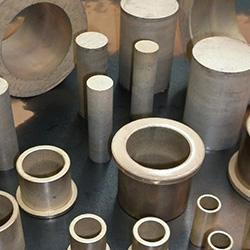
The component is almost ready. It’s gained its form, and that shape really is geometrically exquisite. Let’s say this workpiece is destined to be a form-fitting bushing. It’s partially porous, and tiny capillaries have formed throughout the alloy part. That having been said, the metal particles are still separate. They’re in contact, pressed up against each other due to the immense compaction energies that were applied in the previous stage, but they haven’t yet coalesced into a single mass. To kick off this phase, the furnace melts the lubricants and softens the base metal. Next, the true sintering work commences.
Entering the Sintering Furnace
Heated until the furnace temperature is almost hot enough to melt the in-process alloy mix, the discrete particles fuse and consolidate, one to the other, each to its neighbour. Instead of a mass of tightly segregated metal grains, the tiny granules merge together into a single capillary-filled body, which retains its shape, as imbued by the compaction mechanism. From here, the third furnace treatment phase is encountered. The hot, fusion packed part rolls into a cooling chamber. More than a temperature equalizing chamber, the atmospherically controlled space is sealed so that the sintered metal can’t oxidize. Here’s a short list of the atmospheric controllers used in this oxidation prevention stage:
• A vacuum, which isn’t actually a control gas
• Nitrogen/Hydrogen gas (disassociated ammonia)
• Endothermic gaseous atmospheres
Critically, the generation of a suitable sintering gas can only be decided after the nature of the workpiece alloy is determined.
The goal of the sintering process is to metallurgically fuse, to coalesce and blend powdered metal particles without causing those granular bits to melt. The grains fuse, they bond to their adjacent neighbours. Under controlled circumstances, the sintering equipment heats a subject component, one that’s just been compacted. Eliminating oxidization influences, diffusing the grain boundaries, the formerly compacted workpiece is transformed into a solid mass. Solid, yes, but the mass still incorporates a measure of porosity, through which a lubricating agent can flow. Finally, using a rapid cooling mechanism and an atmospherically controlled gas, the process can sinter harden the outgoing product and imbue it with martensitic strength.