
Calculation of Sintering Temperature? How is it done?
Sintering technology is ruled by complex engineering equations. There are holding temperatures and material characteristics to regulate, plus a slew of phase transforming processes to regulate. Simply put, there are recipes to follow, and those recipes contain a whole lot of mathematically controlled elements. Nothing is left to chance. Of those many processing variables, sintering temperature is regarded as a major recipe catalyser. Come on, let’s see what’s cooking.
What Is Sintering Temperature?
Leaving the kitchen-themed metaphors behind, we return to manufacturing science, to elements that form the backbone of what’s known collectively as powder metallurgical processing. Sintering temperatures, the structure manipulating parameter under our virtual microscope today, control key morphological properties within P/M produced products. The porosity fraction rises or falls, dependent on this value. Mechanical properties vary, grain sizes grow and shrink, all because the sintering temperature is varied by a process engineer or an automated program, one that’s seeking the correct features balance, as desired by a quoted application.
Calculating the Thermal Values
If the material and structural characteristics of a sintered component alter as the temperature varies, the ability to calculate and then set a sintering temperature gives us mastery over a product’s shape and mechanical strengths. Porosity properties also fall under the sway of this controllable process parameter. That being said, how are sintering temperatures calculated? To answer that question, imagine the formula constants. The constants in question are determined by the alloying metal, by carbon content, and several other incomprehensible formula coefficients. Complicating matters, the compaction technique and furnace temperature profile affect the product’s strength, porosity and dimensional symmetry.
The Software-Facilitated Answer
As talented as a process engineer must be, this smart individual can’t park himself next to the sintering equipment with a notepad and pen while he taps numbers into an electronic calculator. No, this is a job for a specialized software package. Capable of running millions of sintering temperature calculations per second, the software carries out simulations, compiles compaction-related datasets, and it generally controls the atmosphere within the sintering furnace, even as it simultaneously monitors compaction pressure.
Generally speaking, the goal is to keep the sintering temperature below its melting point. Sintered particles fuse, they don’t melt. To make this process possible, the furnace heats the powder until it’s roughly two-thirds of the way towards its melting point. Of course, generalities are avoided in science, although they serve us well when we’re looking for a quick and dirty set of processing guidelines. From here, the software takes over by plugging scores of process manipulating engineering datasets into dozens of complicated equations.
Sintering is all about post-compaction heating, about finding a way to control the coalescence of metal powders. Knowing the definition helps, of course, but it doesn’t really tell us what’s taking place within the coalescing mass. That’s a harder system to understand, but its various mechanisms have been examined in some depth. It begins with a pre-heating phase, a process that’s split into three stages.
Post-Compaction Preheating
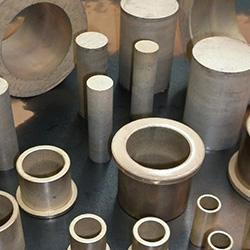
The component is almost ready. It’s gained its form, and that shape really is geometrically exquisite. Let’s say this workpiece is destined to be a form-fitting bushing. It’s partially porous, and tiny capillaries have formed throughout the alloy part. That having been said, the metal particles are still separate. They’re in contact, pressed up against each other due to the immense compaction energies that were applied in the previous stage, but they haven’t yet coalesced into a single mass. To kick off this phase, the furnace melts the lubricants and softens the base metal. Next, the true sintering work commences.
Entering the Sintering Furnace
Heated until the furnace temperature is almost hot enough to melt the in-process alloy mix, the discrete particles fuse and consolidate, one to the other, each to its neighbour. Instead of a mass of tightly segregated metal grains, the tiny granules merge together into a single capillary-filled body, which retains its shape, as imbued by the compaction mechanism. From here, the third furnace treatment phase is encountered. The hot, fusion packed part rolls into a cooling chamber. More than a temperature equalizing chamber, the atmospherically controlled space is sealed so that the sintered metal can’t oxidize. Here’s a short list of the atmospheric controllers used in this oxidation prevention stage:
• A vacuum, which isn’t actually a control gas
• Nitrogen/Hydrogen gas (disassociated ammonia)
• Endothermic gaseous atmospheres
Critically, the generation of a suitable sintering gas can only be decided after the nature of the workpiece alloy is determined.
The goal of the sintering process is to metallurgically fuse, to coalesce and blend powdered metal particles without causing those granular bits to melt. The grains fuse, they bond to their adjacent neighbours. Under controlled circumstances, the sintering equipment heats a subject component, one that’s just been compacted. Eliminating oxidization influences, diffusing the grain boundaries, the formerly compacted workpiece is transformed into a solid mass. Solid, yes, but the mass still incorporates a measure of porosity, through which a lubricating agent can flow. Finally, using a rapid cooling mechanism and an atmospherically controlled gas, the process can sinter harden the outgoing product and imbue it with martensitic strength.