
How Powdered Metals Convert for the Strength You Need
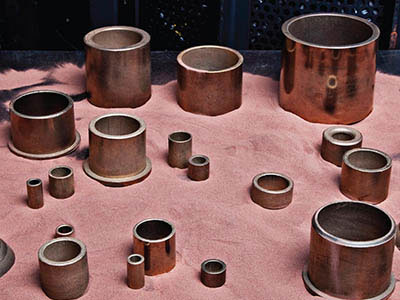
Historically speaking, powdered metals are recognized as moderately strong materials. They form relatively hard bearings and other self-lubricating items. By heat treating sintered metal parts, they become even tougher. In point of fact, the sintering process uses thermal energy and pressure, so some heat treated hardenability is applied during the production phase. Okay, this strength-conversion methodology feels a little nebulous. Just think, wouldn’t it be better if powdered metal parts could be strengthened, toughened and made fatigue resistant with the flip of a switch?
Injecting Alloying Materials
Well, it’s not a physical switch, but this material-strengthening approach does add a process controlling edge to the production line. It goes something like this: Since powdered metals use special engineering recipes, why not add hardenability ingredients to the blend? Molybdenum is considered a hardness agent, as is nickel. Like the alloys that strengthen stainless steel, those metallic elements create generously toughened powder metal parts. Of course, such metals force production costs higher, which is a problem. One answer to this conundrum is to substitute chromium, a capable but affordable metal hardener, into the powder blend. Unfortunately, this approach isn’t without problems, including oxidizing issues. Let’s move onto a second product strengthening technique, one that’ll satisfy the most demanding customers.
Compaction Control Mechanics
Microscopically assessing the atomized powders, the engineers in charge observe the powder’s morphology. It’s a spheroidal mass of tiny particles. Using the latest chemical and mechanical pulverization methods, those that assure featureless particle geometries, the fine-grained load enters the sintering tumbler as a liquid metal stream. In truth, the mass is made of tiny particles, not a liquid base, but it’s so finely atomized that it behaves like a fluid. Now, extreme pressures are applied, thermal curves are controlled, and the sintering process is executed. Because of the particle morphology, that featureless spheroid shape, the particles weld together. Capillary action and porous voids are still part of the design here, but the compaction stage favours strength over material porosity. Essentially, because the particles are finer and smoother, they weld together more easily. Fewer gaps are left behind, so the material becomes denser and harder.
Pressing and sintering control mechanisms regulate powdered metal strength. There are also strengthener additives and hardness heat treatment cycles to further reinforce their strength. Converting to match a client’s design specs, resilient alloys also imbue sintered products with a high degree of durability and fatigue-resisting power. However, such alloys can be expensive, so much so that the process becomes exorbitantly pricey. Currently, chromium is the most cost-effective option here, although the process then must account for oxidization issues.

Shaft runout is described as a centreline deviation issue. To illustrate this drive transmission glitch, imagine the rod of a drive shaft. It moves around its axis, always. Should the drive rod’s centre of radial motion stray, it’ll develop runout. This drift movement is clearly undesirable. Nonetheless, runout problems and misalignment errors can occur in drive systems that utilize sintered bearings. Let’s address the common causes, here and now.
Undue Inner Surface Wear
There are scores of sintered metals on the market. A ferrous bushing supports a high load somewhere in a factory while a bronze bearing carries out a similar role in a chemically active zone. Again, there are different materials available. If a softer alloy is exposed to vibration, to loading effects, or some motion-interfering abrasive, the inner surfaces of the bearing will experience wear. As the abrasive action grows, a wobble develops in the shaft until an unacceptable amount of shaft runout compromises drive kinetics.
Transient Loading Effects
Typically, this scenario applies to softer alloys. Powder metallurgical strength is imparted when sintered bearings are mounted. They’re rigid and hard, but that strength is held in check somewhat by the bearing type’s porous structure. Moderately strong and solid, catastrophic transient forces can damage the bearings or cause misalignment problems. Shaft runout develops as the clearance-related defect worsens.
Press Fit Clearance Headaches
Between 30 to 40 percent of a standard rolling element’s race contacts a shaft when it uses press-fit securing. That number drops lower on sintered bearings because of their slightly porous build. As micro-movements build up on the surface-to-surface joint interface, the clearance between the bearing and shaft widens. Shaft runout is the result. The movement is experienced laterally and as an angular wear pattern. Consequently, “fretting” wear is a known enemy here, one that can impact the necessarily tiny clearance values that separate a press-fitted sintered bearing and its rotating shaft.
Accumulated Stress Factors
A nearly imperceptible quantity of shaft deflecting force is impacting an energy transmitting system and causing a misalignment error to expand unchecked. There’s dirt in the mountings, and the self-lubricating film is sucking in a few grains of filth. The temperature is high in here, so alloy elasticity is higher than average. In short, numerous stress factors are hampering the laterally contacting joint area, and the interface is breaking down. Shaft runout errors are almost certain to develop unless those side forces, high temperatures, and foreign materials are reduced.
As a mark of quality, sintered bearings perform optimally under all kinds of conditions. Like any other mechanical component, however, that’s a conditional statement, not an absolute. Shaft deflection tests can pinpoint such misalignment errors before they cause permanent and irreversible bearing damage.