
What is Infiltration of Powdered Metals?

Imagine the powder metallurgical process as a series of illustrated steps. The powders and additives mix, then they’re formed and sintered. The process is clearly marked out in the various illustrations. Adding another illustrated block to the process, infiltration action strengthens powder metal components. Basically, the technique adds a second metal to the part, and that alloy fills the part’s porous structure. The metal “infiltrates” the pores.
Pore Infiltration Technology
So, what’s the big idea? Powdered metals use their pores to store lubricating agents and other additives. That’s the whole purpose of this process, right? Well, there are some applications where powdered metallurgy is desired, but it can’t be properly applied because the pores undermine a product’s load-bearing capabilities. The product engineer wants porosity, wants powdered metals and all the benefits they carry, but he doesn’t want that slightly reduced material density. To overcome this drawback, infiltration technology is recruited. The goal is to fill the pores with a liquid metal, an alloy that has a lower melting point than the powdered metal.
Low Melting Point Alloy Infiltration
And that’s the key point here, the low melting point of the infiltrating alloy. Heated, the powdered metal retains its compacted and sintered outlines. Meanwhile, the second metal melts and flows. It uses capillary action to penetrate a component’s pore system and densify the P/M manufactured product. Temperature management programs are essential when carrying out this action, as is a precisely administered sequence of time-based steps. There are hold times and metal fluidizing periods to manage, plus a number of other highly sensitive flow issues to handle. Next, let’s move onto the base metals and the low-temperature flow agents.
Determining the Penetration Alloy
For ferrous-rich alloys, the melting temperature of a sintered component is high. A great deal of energy was expended when the component was compacted and sintered, but its pore system is undermining a normally superhard structure. Injecting molten copper as a pore-penetrating medium, the iron gains a brownish tint. It’s harder, denser, more corrosion resistant, and it’s also now a weldable material. Those mechanical and chemical enhancements wouldn’t exist, not without the copper infiltration stage working its densifying magic.
Reinforcing P/M manufactured components, infiltration procedurals rely on the properties of a low temperature penetrant. Copper is one such material, which improves the corrosion and strength of powdered iron. Then there are ceramic slurries and other exotic materials, which alter the behaviour of formerly porous metal bases. Essentially, used as a secondary property-enhancing operation, infiltration technology is used to fill pore systems. The process seals or strengthens sintered components, makes the part corrosion resistant and/or makes the part more machinable.

There’s a tendency to put self-lubricating bearings in their own applications spotlight. Alternatively, given the chance, curious would-be engineers should try giving other powdered metal parts their chance to shine. Granted, bearing technology owes a lot to powder metallurgy, but there is a whole other range of equally capable powder-fabricated products, all of which use their porous structures to good effect. Filtration systems are one popular example, then there are powdered and sintered gears, plus many more examples.
Classifying Powdered Metal Parts
Strictly speaking, powdered metal parts are made out of mountains of atomized material. At least that’s how the process begins. Then, acting as the pressing and bonding force, the sintering stage shapes the discrete particles into a solid form. Of benefit to rotating shafts, low maintenance bushings and bearings are produced when the powder is mixed with a lubricating agent. Porous by design, the end product “sweats” slippery oil. Again, this is the application that most trainee engineers think about when they first get involved with powder metallurgy. Shifting gear, let’s push way beyond this key application base. Let’s see some other examples of powdered metal parts, ones that rely on this specialized fabrication method.
The Benefits of Controlled Porosity
Solid filtration components employ this principle when challenging, tortuous environments demand precise fluid sieving mechanisms. Made of a toughened metal, the filters channel high-pressure, high-temperature fluid loads in oil refineries and chemical processing plants. Mounted in a caustic processing line, a corrosive atmosphere can’t damage a porous chunk of metal. Likewise, pressurized hydraulic and pneumatic systems employ metals and glasses, ceramics and engineering plastics. All of those pressure retaining materials expand and compress at different rates, unfortunately. It’s tough to fit a metal cap or seal that can expand at a similar rate. Using a similarly specified PM produced component, the powder metal part is imbued with a low coefficient of thermal expansion, so its expansion rate mirrors the cylindrical valve it’s sealing.
In the first generation of sintered products, self-lubricating bearings took flight. Bushings conquered maintenance problems and oil-feed issues. Then came filtration solutions, intricately shaped gears, and more. Now there are powder metal parts that satisfy hundreds of different usages. Carriage bushings move on rails while delivering that same ever-handy self-lubricating feature. Then there are magnetically charged powdered components, which add exotic powders to the mix. Just by altering compaction pressure and sintering temperature, the magnetic strength of a geometrically sophisticated component is easy to manipulate. This feature, now popular in the automotive industry, is opening new avenues for the powder metallurgical sector.
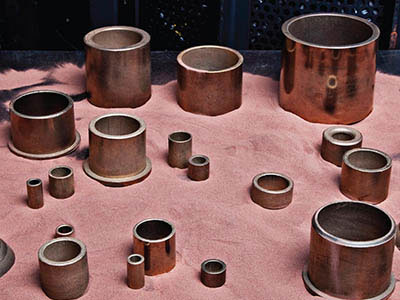
Historically speaking, powdered metals are recognized as moderately strong materials. They form relatively hard bearings and other self-lubricating items. By heat treating sintered metal parts, they become even tougher. In point of fact, the sintering process uses thermal energy and pressure, so some heat treated hardenability is applied during the production phase. Okay, this strength-conversion methodology feels a little nebulous. Just think, wouldn’t it be better if powdered metal parts could be strengthened, toughened and made fatigue resistant with the flip of a switch?
Injecting Alloying Materials
Well, it’s not a physical switch, but this material-strengthening approach does add a process controlling edge to the production line. It goes something like this: Since powdered metals use special engineering recipes, why not add hardenability ingredients to the blend? Molybdenum is considered a hardness agent, as is nickel. Like the alloys that strengthen stainless steel, those metallic elements create generously toughened powder metal parts. Of course, such metals force production costs higher, which is a problem. One answer to this conundrum is to substitute chromium, a capable but affordable metal hardener, into the powder blend. Unfortunately, this approach isn’t without problems, including oxidizing issues. Let’s move onto a second product strengthening technique, one that’ll satisfy the most demanding customers.
Compaction Control Mechanics
Microscopically assessing the atomized powders, the engineers in charge observe the powder’s morphology. It’s a spheroidal mass of tiny particles. Using the latest chemical and mechanical pulverization methods, those that assure featureless particle geometries, the fine-grained load enters the sintering tumbler as a liquid metal stream. In truth, the mass is made of tiny particles, not a liquid base, but it’s so finely atomized that it behaves like a fluid. Now, extreme pressures are applied, thermal curves are controlled, and the sintering process is executed. Because of the particle morphology, that featureless spheroid shape, the particles weld together. Capillary action and porous voids are still part of the design here, but the compaction stage favours strength over material porosity. Essentially, because the particles are finer and smoother, they weld together more easily. Fewer gaps are left behind, so the material becomes denser and harder.
Pressing and sintering control mechanisms regulate powdered metal strength. There are also strengthener additives and hardness heat treatment cycles to further reinforce their strength. Converting to match a client’s design specs, resilient alloys also imbue sintered products with a high degree of durability and fatigue-resisting power. However, such alloys can be expensive, so much so that the process becomes exorbitantly pricey. Currently, chromium is the most cost-effective option here, although the process then must account for oxidization issues.

Shaft runout is described as a centreline deviation issue. To illustrate this drive transmission glitch, imagine the rod of a drive shaft. It moves around its axis, always. Should the drive rod’s centre of radial motion stray, it’ll develop runout. This drift movement is clearly undesirable. Nonetheless, runout problems and misalignment errors can occur in drive systems that utilize sintered bearings. Let’s address the common causes, here and now.
Undue Inner Surface Wear
There are scores of sintered metals on the market. A ferrous bushing supports a high load somewhere in a factory while a bronze bearing carries out a similar role in a chemically active zone. Again, there are different materials available. If a softer alloy is exposed to vibration, to loading effects, or some motion-interfering abrasive, the inner surfaces of the bearing will experience wear. As the abrasive action grows, a wobble develops in the shaft until an unacceptable amount of shaft runout compromises drive kinetics.
Transient Loading Effects
Typically, this scenario applies to softer alloys. Powder metallurgical strength is imparted when sintered bearings are mounted. They’re rigid and hard, but that strength is held in check somewhat by the bearing type’s porous structure. Moderately strong and solid, catastrophic transient forces can damage the bearings or cause misalignment problems. Shaft runout develops as the clearance-related defect worsens.
Press Fit Clearance Headaches
Between 30 to 40 percent of a standard rolling element’s race contacts a shaft when it uses press-fit securing. That number drops lower on sintered bearings because of their slightly porous build. As micro-movements build up on the surface-to-surface joint interface, the clearance between the bearing and shaft widens. Shaft runout is the result. The movement is experienced laterally and as an angular wear pattern. Consequently, “fretting” wear is a known enemy here, one that can impact the necessarily tiny clearance values that separate a press-fitted sintered bearing and its rotating shaft.
Accumulated Stress Factors
A nearly imperceptible quantity of shaft deflecting force is impacting an energy transmitting system and causing a misalignment error to expand unchecked. There’s dirt in the mountings, and the self-lubricating film is sucking in a few grains of filth. The temperature is high in here, so alloy elasticity is higher than average. In short, numerous stress factors are hampering the laterally contacting joint area, and the interface is breaking down. Shaft runout errors are almost certain to develop unless those side forces, high temperatures, and foreign materials are reduced.
As a mark of quality, sintered bearings perform optimally under all kinds of conditions. Like any other mechanical component, however, that’s a conditional statement, not an absolute. Shaft deflection tests can pinpoint such misalignment errors before they cause permanent and irreversible bearing damage.
Based on powder metallurgy technology, sintered bronze bearings deliver a very familiar feature. That opening sentence is, of course, referring to the material’s porous build. Friction counteracting lubricants are stored inside the metal’s tiny chambers. Okay, so this general property gets mentioned in every article, because that’s what the bearings do best, but there’s more to this technology than that self-lubricating feature.
Bronze-Elevated Sintering Features
Made from copper, the metal is infused with a measured quantity of tin. Around 10% of the alloy is tin, so the remaining 90% is copper. Furthermore, the alloy is readily available, so it’s not an expensive blend. Just the opposite, bronze is a popular fabrication metal. Used for statues, sculptures, contacts in electrical circuits, and the plumbing profession, the orange-brown metal is found in countless applications. But those typical usage areas rely on cast metals, on extruded and rolled bronze. For bronze bearings, the sintering process replaces clumsy castings. Bearings made of sintered bronze feature the following invaluable material properties:
- Self-lubricating
- Corrosion resistant
- Enhanced workability
- Popular in marine applications
- Durable and fatigue resistant
Improving Bronze Bearings
This material and its self-lubricating properties have been described in detail before. We know the metal thrives in marine components. We also know bronze bearings encourage capillary action, so an oily film forms quickly, pretty much as soon as a bearing spins up to speed. Having covered the advantages, let’s save a mention for a single drawback. If a shafted machine isn’t used often, it starts erratically, or it’s bogged down by a heavy load, then sintered bearings can run into trouble. To offset such problems, sintering engineers use higher material porosity values, special substrate bonding processes, and advanced lubricants. Sure, an older generation bronze bushing may emit a squeal of protest when a shaft starts to rotate, but these advanced-design bronze bearings handle infrequent usage patterns quite well, all thanks to bronze’s innate material properties.
It’s a balancing act, like any other engineering process. Higher porosity bronze, perhaps as a high as 40% oil-permeable, is obviously achievable, but a stronger alloy will be needed to offset the weaker structural build. Alternatively, bearing designers often opt for thicker bronze bushings, but this option only works in an application that can afford the additional space. Finally, just to bolster this rust and fatigue resistant alloy further, some manufacturers have decided to fuse bronze, to bind it to layers of load-supporting steel. With this last feature in mind, expect composite bronze bushings to take their place in heavier industrial applications.
Let’s match two manufacturing giants, toe-to-toe and kilo for kilo. On one side, there’s the machining industry. It’s not going anywhere, but there are certainly times when this sector could benefit from a few process-oriented refinements. As for the competitor, this is a heavyweight. Sintering technology is, by its very nature, a refined and economical manufacturing technique. Here, check out the two standards in action.
Repeatable and Economical Sintering
A workpiece is moving through the sintering equipment. There are dies and compacting assemblies at work, which are introducing pressure and heat into the process. Every component looks identical, so repeatability is assured. In manufacturing plants and production lines, that process constraint is prized above just about every other procedural coefficient, right? Anyway, on popping over to the machining floor, things are proceeding nicely. Only, a saw blade is blunt. A drill bit is also fractured or moving irregularly. Even the extrusion machinery is faltering. Okay, this is an unlikely scenario, but any one of these faults could occur. The point is this: machining solutions don’t always produce consistent results.
Quench Hardened Equivalents
Downtime issues aside, there’s another reason why sintering metals beat out their machined counterparts. In the post-production stage, the newly formed workpieces aren’t hardened. A second post-production phase is ordered, one that case hardens the product line. In the sintering process, the same workpieces are already heated and compacted, and it’s not difficult to use that thermal energy as a sinter hardening mechanism. Compare that process benefit with the separate heat treatment operation used on the machined components. It costs more to use a secondary heat treatment operation, and those costs are exacted in terms of money and time. Oftentimes, sintering metals are heat treated on the spot, simply by manipulating the thermal energy that initially aided the compaction stage.
Sidestepping Multi-level Tooling
Intricate tool heads and forming instruments require special multi-plane mechanisms, which operate orbitally. The machines are incredibly precise, but they’re also incredibly expensive. However, to meet certain geometrically ordained product specifications, those 5 and 6-axis machines are essential. In the sintering equipment, such high-tolerance dimensional specs are part-and-parcel of the job. Incidentally, even if the CNC machined parts are dimensionally accurate, that post-production heat treatment stage could change those dimensions, just finitely, which is more than enough to void the operation in many detail-oriented engineering facilities.
Economical by design, sintering metals discharge consistently from high-volume production lines. Should heat treatment work be process-integral, the operation can be added to the cooling phase, right where the heating and compaction work takes place. Machining facilities, although fast and accurate, can’t match this feature. After the machine work is complete, a whole other job is required to harden and otherwise treat the machined parts.

Processing plants use catalysts to trigger active chemical reactions. The material makeup of this substance makes it possible for previously unsustainable compound alterations to take place. Alternatively, catalysts accelerate existing chemical reactions. Once upon a time, as all stories begin, solid metals were used to facilitate such processes. They transformed compounds, acted as oxidisers, and generally performed their alchemic duties well. Now, however, powder metal is preferred, but why?
Dimensionally Liberated Powders
The only thing slowing down a solid metal, as it carries out its chemically reactive efforts, is its geometry. The pellets and plates offer up their outer surfaces, and newer improvements have even made the solid metal elements partially porous, but that fixed volume aspect does limit what should be an accelerated chemical reactance rate. And, since some catalytic operations work better when they have access to more surface area, then powder metals have a clear advantage. For example, certain powder metals are currently being used to advance battery technology.
Utilised as Particulate Additives
Added to biofuels as a fluid-suspended ingredient, the combustible efficiency of the fluid increases. The powder metal minimises harmful emissions, supports an improved combustion cycle, and performs as an oxidation temperature mitigator. Again, the nanopowder uses its larger surface area, diffused throughout the fluid, to exceed the capabilities of a similarly composed solid metal catalyst. It just wouldn’t be practical to fill a biofuel fluid container with plates or metal wool, not when an atomised catalyst can do the job so much better. Although, returning to porous solid metal catalysts, this hybridised product does provide a larger volume of fluid-to-metal reactance space, which comes about because a nominated chemical can gain access to more of the metal’s surfaces, even when those surfaces aren’t exposed.
Solvent-strength Metal Catalysts
Freed from their solid crystalline matrices, powder metal acts as a fluid solvent. It also requires less energy to accommodate this chemically reactive action. If the catalyst is desired at a required reactance point, the current in a battery electrode can provide the electromechanical impetus. Alternatively, perhaps in an alloy treatment plant, the morphology of the solvent-suspended powder responds to other easy-to-manipulate forces, including magnetism. Simply by manipulating the flux capacity and hysteresis losses inside a processing environment, the powder metal is efficiently regulated and managed in a way that a conventional solid metal catalyst cannot emulate.
Formed into porous metal components, powder metals exert great influence over the bearings market. Elsewhere, back at the powder atomisation stage, certain distinguished metals are used as free-floating chemical catalysts. They’re classed as metal solvents, as materials that provide more volume than a solid metal catalyst could ever manage.
On occasion, when sintered components need to exhibit a predetermined quantity of mechanical toughness, the parts are subjected to special supplementary operations. The finishing service, which is typically carried out in-house, further hardens a sintered component’s internal structure. Now, heat treatment principles obviously dominate this post-production phase, but there are other secondary hardening methods of interest here, which also take place at the end of the production run.
Repressing
A newly sintered part, having completed the entire powder metallurgy process, balances its ingrained hardness classification against a desired porosity ratio. Alternatively, the component can be densified. Exposed to a secondary repressing phase, the component is placed inside a closed die, pressed uniformly, and heated. As the sintered material becomes denser, it hardens.
Steam Treatment
Viewed as a heat treatment offshoot, near melting point thermal curves are not required here, yet the powder-manufactured components do gain a case-hardened finish. Essentially, the process uses steam and heat to oxidize the metal’s surface. By applying more steam and sustaining the thermal energy for a predetermined period, the hardened finish goes deeper.
Post-Production Impregnation
In this supplementary hardening procedure, powder metallurgy parts no longer use their porous structures as an oil-filled system. However, the component can still deliver a powerful quantity of self-lubricating might if the right filler is employed. For example, fluoropolymer fillers seal the pores while simultaneously providing a Teflon-coated lubricating feature. Otherwise, a second metal can be used as the filler, one that again densifies the normally porous material base.
Precipitation Hardening
Carried out in a vacuum furnace or a heated enclosure that pumps in an inert gas atmosphere, a single-phase solution takes form within the PM manufactured metal. Precipitates are produced as the thermal energy in the furnace climbs. Locking this metallic phase in place, the sintered parts are rapidly cooled in water or oil. The fine-grain metal still contains a porous sub-structure, but that metal grain is finer and harder.
Case Hardening
Precipitation technology works well on certain alloys. However, in powder metallurgy work, there’s a need for niobium or some other exotic metal, which facilitates the precipitate formation stage. Unlike this exacting heat treatment method, case hardening tech is a little more flexible. Available hardening methods here include induction hardening, plasma nitriding, and carbonitriding.
Powder metallurgy tech creates hardened components. If a client or application requires a harder metal, then repressing or steam treatment work provide a cost-effective avenue. Then, for those applications that absolutely demand the services of a heat treatment process, there’s case hardening work or the even denser precipitation hardening process.
Powder metallurgy represents something of an ideal production model. There are no costly castings to produce, and the bearings possess a highly desirable self-lubricating feature. It’s also possible to make sintered bearings without incorporating a post-production stage, although this part of the operation is often recommended. With that said, apart from the end-phase jobs that machine and polish the pressed-metal rings, is heat treatment work an obligatory step?
Heat Treatment Pitfalls
The sintering process creates an elaborate system of pores within the bearings. Through those pores, a lubricant is discharged until a fine film encircles the bearing ring. This is capillary action, a principle that occurs when bearings spin. Now, this intricate cluster of pores, penetrating the entire bearing, function very well indeed. Unfortunately, a poorly configured heat treatment cycle can impede capillary action. Furthermore, certain metals and chemical additives are known to oxidize when they’re exposed to great quantities of heat.
Reviewing the Benefits
As a desired post-production phase, heat treatment does deliver certain essential benefits. The sintered metal, loaded with pores, could be fracture-prone. A case hardening or induction hardening furnace would clearly remove that underlying flaw. Further heat work and an accompanying tempering stage would take this operation further, perhaps by making the sintered bearings entirely fatigue-resistant. In conclusion, this is a powerful tool, one that’s designed to improve the mechanical characteristics of sintered bearings. However, the process can also impede product capillary action or even oxidize the alloying metals within the pressed metal because of some unpredictable catalyzing event.
Heat Treatment Alternatives
Again, heat treatment is an essential tool to have on hand, but it’s not always the best way forward. For example, standard self-lubricating bearings are capable of handling light to moderate loads. For heavier loads and transient radial forces, employ a more durable alloy or a lower porosity ratio. As long as the shaft rotates at a high enough velocity, hydrodynamic action will spread the lubricating agent. Lastly, again as an alternative to heat treatment, research steam treatment options. Designed to intelligently add an oxidized layer of magnetite, this process does not mechanically alter the makeup of the bearing alloy.
Heat treatment processing is conducted at the end of a sintered bearings production journey, but it’s still considered an elective phase. Granted, harder bearings do overcome load-limiting porosity problems, but the heat can also create as many problems as it solves. For light to moderate applications, purely sintered bearings are often more than good enough. Then, for heavier applications, consider stronger alloys or non-transformative steam treatment instead of a full-out material conversion operation.
Powder Metallurgy equipment is gaining traction, which is to say the gear is finding its way into more industrial settings. Is this because there’s no forging equipment to operate? Developed as a powder compaction process, there’s no furnace or poured metals, which then have to cool before they can be ejected from their castings. No, sintered metals are compacted and heated, and there’s even a process option that allows for additive mixing. Surely those advantages have earned the tech an advantages-promoting review, yes?
Advantage Promotion: The Environmental Benefit
Having made that decision, let’s start with the no-wastage perk. Since the powder is pushed into its final shape by a die, there’s no wasted heat or materials to deal with on the factory floor, nor are there any processing chemicals to dispose of after the production line has finished its work.
The Machine-less Production Method
Using precisely manufactured dies and inserts, a component is pressed into shape. That action can be initiated repeatedly, and it’ll always yield dimensionally consistent end-cycle products. Optionally, the process may incorporate some minor post-finishing work, but very little machining will go into that extra work. More likely, the post-production stage will heat treat or polish the almost finished workpieces.
Equipped with Capillary Action
Powder metallurgy equipment uses a T-shaped processing aperture, right at the start of the sequence. On one arm of the T, there’s the powder. For the other end, a waxy or liquid lubricant enters the mixing chamber. Churned until it’s a homogenized blend, the powder/lubricant mix leaves the sintering process with a porous structure, one that’s filled with trace amounts of friction-minimizing oil. Sintered bearings, for example, feature a self-lubricating design.
Production Scalability
Slow-moving forgings eject after an age. Meanwhile, in a sintering station, the powder and additive recipes can be altered at a moment’s notice. If the production numbers have dropped, it’s not hard to give those figures a bump. Higher volume runs are easier to establish. Moreover, different alloys, no matter the grade, all react similarly to the sintering process. Traditional metal forming techniques simply can’t match that advantage.
The malleable mountains of atomized powder mirror the production line’s most versatile processing attributes. Still, even equipped with what’s essentially a flexible product forming method, the results exit the machinery with consistently dimensioned product profiles. There’s no waste, no excess thermal energy, and usually no machine shop stage to squander on an otherwise healthy productivity margin. Instead, turnkey metal forming work comes through, with its workpiece forming mechanisms opting for powdery recipes, not molten metals and their inflexible, intransigent forging moulds.